The iGaming calendar never really stops. There’s always another city, another venue, another badge to collect and another booth to visit. For anyone trying to build genuine partnerships in this industry, the question of how to spend your time and budget at events is one of the most consequential decisions you make all year. At Wynta, we spend a lot of time thinking about what makes affiliate relationships actually work, and that conversation inevitably leads back to the same place: the people. So we sat down with someone who has an unusually clear view of how those people find each other.
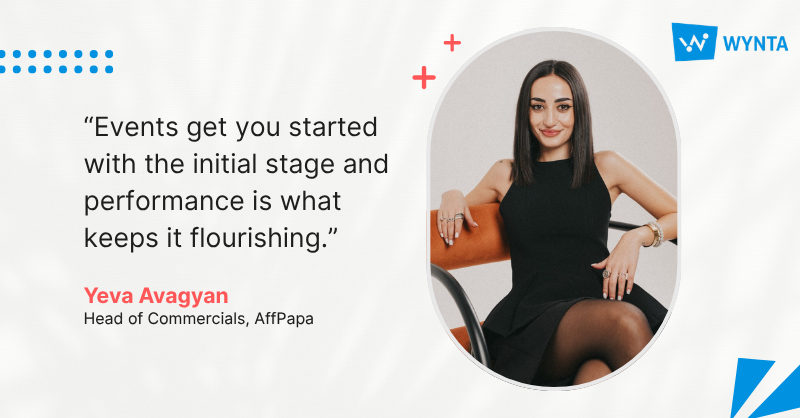
Yeva Avagyan is Head of Commercials at AffPapa, the iGaming directory that has been connecting operators and affiliates since 2020 and now counts over 300 operators and 2,300 affiliates within its ecosystem. AffPapa sits at a distinctive vantage point in the industry, not as a network extracting commission from every introduction, but as a directory designed to put the right people in front of each other and then step back. Yeva oversees the commercial relationships that make that happen, and she’s watched the dynamics of how partnerships form and fail across hundreds of connections. Her perspective on events, trust and where the industry is heading is worth understanding.
Being Strategic With Your Events Budget
The iGaming events calendar has become genuinely difficult to navigate. ICE, SiGMA, iGB, the growing AffPapa Conference series and dozens of smaller regional gatherings all compete for the same budget and the same two or three days out of the office. For operators and affiliates trying to be deliberate rather than reactive, the choice of which events to attend is a real strategic decision.
Yeva’s framework is straightforward, and deliberately unsentimental about the allure of marquee events. “Since there are multiple good shows happening close together, I’d say put into priority those that are in alignment with your target markets and where your key partners will be,” she says. “I think every event has its value, but being selective is key. Choose events based on the actual outcome you want and not just the hype.“
That distinction, outcome versus hype, is one that most people in the industry would agree with in principle but fewer act on in practice. The largest events carry a gravitational pull that can make attendance feel obligatory regardless of whether the specific audience matches your objectives. In reality, a smaller event in the right market with the right attendee profile will often produce better ROI than a giant show where your target partners are distributed across ten halls and four days of competing sessions.
AffPapa’s own data reinforces this. The company’s 2025 expansion into Latin America, including its inaugural iGaming Awards LATAM in Cancun, was a direct response to the growing importance of regional presence, the recognition that being at the right event in the right market matters more than simply being at the biggest event anywhere.
What Actually Builds Trust
One of the more persistent myths in any relationship-driven industry is that trust is built at events. Yeva is clear-eyed about what events actually do. And what they don’t.
“Let’s keep it simple – events are there to build a first impression, like a jump-start. You meet people, feel the chemistry and understand the full potential of the opportunities to collaborate. But real trust is built in the work – how you deliver, how you keep your communication, handle issues etc. Events get you started with the initial stage and performance is what keeps it flourishing.“
This framing matters because it changes how you approach event preparation. If an event is a jump-start rather than a destination, the quality of what follows: the responsiveness, the transparency, the ability to deliver on what was discussed becomes the actual measure of whether the event was worth attending.
For affiliate managers specifically, this is a useful lens. The deals that hold up and grow over time are the ones where both sides trust the data, trust the communication, and trust that problems will be handled rather than hidden. Events create the opening. Everything after is where the relationship is actually built or lost.
The Shift Towards Smaller, More Focused Events
Perhaps the most significant trend Yeva has observed from her position at the centre of the iGaming affiliate community is a reorientation in how people think about events themselves.
The appetite for smaller, more focused gatherings is growing and the reason is simple. The format produces better conversations. “The most talked about aspect right now is the growing interest in smaller, more focused events,” Yeva observes. “They tend to be more productive, more personal. You have proper conversations instead of rushed meetings in between stands and a noisy crowd. And honestly those deeper conversations are what actually turn into real partnerships, not dozens of exchanged business cards.“
This is the thinking behind the AffPapa Conference Madrid, taking place from 18–20 May 2026. The event is designed around a curated attendee balance of about 40% affiliates, 40% operators and 20% B2B providers, with expert panel discussions, speed-dating sessions and multiple networking formats built to maximise productive contact time rather than simply maximise attendance numbers. The 5th edition of the AffPapa iGaming Awards will also take place during the conference, held at the historic Real Casino de Madrid on 20th May.
The deliberate calibration of who is in the room is not incidental to AffPapa’s event philosophy, it’s central to it. A well-balanced room means every attendee is surrounded by relevant potential partners. The conversations that happen naturally, between sessions or at dinner, have a significantly higher chance of going somewhere useful.
The Speed-Dating Format and Why It Works
AffPapa’s speed-dating sessions have become one of the most talked-about structural elements of their conferences. The format, structured, time-limited one-to-one meetings between pre-matched attendees, solves one of the most persistent problems at large events: the difficulty of actually getting face time with the specific people you came to meet.
The design philosophy behind it is uncomplicated and Yeva makes no attempt to dress it up. “We built the speed-dating sessions around one simple idea,” she says. “Cut the fluff and get people straight into business.”
In practice, the outcomes have been more substantive than the format’s efficiency-focused premise might suggest. “We’ve seen everything from first introductions that turn into long-term affiliate deals to operators finding new traffic sources they wouldn’t have met otherwise. It’s not just quick chats, it’s actually the starting point for real partnerships.“
The model reflects a broader truth about how affiliate partnerships actually begin. The initial conversation doesn’t need to be long, it needs to be relevant. Two people who understand each other’s business quickly, who identify a potential fit in a few minutes and who leave with a clear next step are further along than two people who spent forty-five minutes at a dinner table talking about everything except whether they should work together.
AI, Automation and the Part That Still Needs Humans
The conversation inevitably turned to AI and what it means for the affiliate management side of the industry. Platforms like Wynta are positioning AI as a meaningful shift in how affiliate programs are operated, handling the operational load of reporting, tracking and campaign management so that the people running programs can focus on the relationships that actually drive growth.
Yeva’s assessment from the ground is measured and practical. A lot of operators, she confirms, are feeling the weight of the operational side: the reporting cycles, the tracking issues, the back-and-forth. That’s where AI adds real value. However, according to Yeva, the core need, finding the right partners and building the relationships that make those partnerships produce results remains fundamentally human. Automation creates the time and headspace to do that relationship work well. It doesn’t substitute for it.
That distinction is one Wynta takes seriously. The goal of automating the operational layer of affiliate management is precisely to give affiliate managers more capacity for the work that actually moves the needle: the conversations, the deal structures, the trust-building that Yeva describes as the real currency of the industry.
If you want to see what a program purpose-built to handle the operational side of affiliate management looks like so your team can focus on the relationships, book a Wynta demo and we’ll show you exactly how it works.