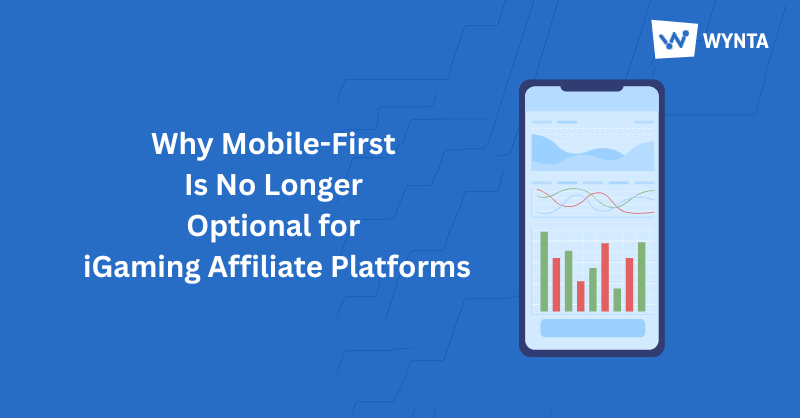
The screen in your pocket has become the most important real estate in iGaming and affiliate platforms are racing to catch up.
Walk into any iGaming operator’s data team meeting today and one stat tends to dominate the conversation: somewhere between 70% and 80% of all iGaming traffic now originates from a mobile device. Players sign up on their phones, check odds on their tablets, claim bonuses while commuting and rarely think to open a laptop. Yet for years, affiliate platforms, the back-end infrastructure that powers the partnerships driving much of that traffic were built with desktop users firmly in mind.
That’s changing fast. Mobile-first design has moved from a nice-to-have feature to a non-negotiable standard, reshaping how affiliate management platforms think about performance, usability and the day-to-day workflows of operators and affiliates alike.
What “Mobile-First” Actually Means
It’s worth being precise here, because the term gets used loosely. Mobile-first is not the same as mobile-compatible. A platform that was built for desktop and later squeezed onto a smaller screen is mobile-compatible at best, a compromise that typically results in crowded navigation, slow load times and interfaces that demand too much from the user.
Truly mobile-first means the platform is designed from the ground up with the smallest screen in mind, then scaled upward. Layout decisions, button sizing, data visualisation, navigation hierarchies, all of it is conceived for a thumb, not a cursor. Desktop functionality is then layered on top, rather than the reverse.
For iGaming affiliate platforms specifically, this distinction matters enormously. Affiliates are often individuals or small teams working across multiple programs simultaneously. They check their stats on the go, respond to commission queries from a café and make decisions about campaigns while away from a desk. If the platform they rely on is frustrating to use on a phone, they notice and they will gravitate toward platforms that work better.
The Performance Imperative
Responsive design is only half the story. A layout that adapts gracefully to a 390px screen still fails if the underlying page takes six seconds to load on a 4G connection. Mobile users are less forgiving of slow performance than desktop users and in iGaming, where operators and affiliates are often making time-sensitive decisions, delays have a direct cost.
The most forward-thinking affiliate platform providers are investing heavily in:
- Adaptive interfaces that don’t simply resize but actively prioritise the most important information for the context. On mobile, that might mean surfacing a top-line performance summary immediately, with deeper reporting a tap away, rather than loading the full dashboard at once.
- Optimised data delivery that reduces payload sizes without sacrificing the depth of reporting that operators and affiliates depend on. This often involves smart caching strategies, lazy-loading of secondary data and thoughtful decisions about which metrics to surface by default on smaller screens.
- Touch-optimised interaction design that accounts for the reality of not-so-dainty fingers and small targets. Clickable elements need adequate spacing. Forms need to work smoothly with mobile keyboards. Navigation should feel natural, not like a shrunken replica of a desktop menu.
- Cross-device consistency so that an affiliate who starts reviewing a report on their phone can pick up seamlessly on a tablet or laptop. State should persist. Settings should carry across. The experience should feel unified, not fragmented.
Why iGaming Raises the Stakes
The iGaming industry places specific demands on affiliate platforms that make mobile performance even more critical than in other sectors.
Compliance requirements mean platforms must present terms, disclosures and player protection information clearly and that clarity must be maintained on small screens, not sacrificed in the name of a clean layout. Regulatory scrutiny in markets like the UK, Sweden and the Netherlands means that important information can never be buried in a menu that becomes inaccessible on mobile.
The volume and velocity of data is another factor. iGaming affiliate programs generate significant amounts of information: clicks, registrations, deposits, player activity, commission calculations and affiliates expect to be able to interrogate that data quickly. Mobile interfaces must make reporting accessible without overwhelming users, which demands careful information architecture rather than a simple port of desktop dashboards.
Finally, the competitive nature of the affiliate space means that platform usability is genuinely a differentiator. Operators compete for the attention of high-value affiliates. An affiliate with leverage will choose to work more closely with operators whose platforms are a pleasure to use.
Introducing the Wynta AI App: Answers on the Go
Mobile-first design changes how platforms look and perform. But the most meaningful shift in how operators and affiliates interact with their programs on mobile may come from a different direction entirely: AI-powered access to information.
Wynta‘s AI app is a guard-railed question-and-answer tool built directly into the platform, designed so that operators and affiliates can ask plain-language questions about their affiliate program’s operations and performance and get immediate, accurate answers.
Instead of navigating through multiple reports to understand why commission payouts shifted last month, an affiliate can simply ask. Instead of a program manager pulling up several dashboards to answer a partner’s query, they can get a clear response in seconds. The Wynta AI app understands the context of your program and responds within defined guardrails, meaning answers are grounded in your actual data and operations rather than generic, one-size-fits-all responses.
This matters particularly in a mobile context. On a small screen, the fewer steps between a question and an answer, the better. Traditional reporting interfaces, however well-optimised for mobile, still require users to know where to look and how to navigate. A conversational AI layer removes that friction entirely. You ask what you want to know, in your own words and the platform tells you.
For operators managing multiple affiliate partnerships, the Wynta AI app means faster responses to affiliate queries, less time spent pulling manual reports and a clearer view of program performance without needing to be at a desk. For affiliates, it means genuine self-service access to the information they need, whenever and wherever they need it.
It is worth being clear about what the Wynta AI app is at this stage: a focused, intelligent Q&A tool. What it does: answering questions about program operations and performance clearly and accurately, and it does this well. That foundation is what makes it genuinely useful rather than a feature that overpromises and underdelivers. Stay tuned for updates on how we’re growing this app!
The Bigger Picture
The shift toward mobile-first affiliate platforms reflects something broader happening across the iGaming industry: the infrastructure that operators and affiliates rely on is being rebuilt around the realities of how people actually work, not how they were assumed to work a decade ago.
Responsive design and optimised performance are table stakes now. The platforms that will define the next few years are those investing in the full experience, interfaces that adapt intelligently, data that loads quickly and tools like AI-powered Q&A that reduce friction at every point of contact.
For iGaming affiliates and operators evaluating their platform choices, mobile capability is no longer a secondary consideration. It is the primary lens through which a platform’s fitness for purpose should be judged.
Wynta is an AI-powered affiliate software platform built for the iGaming industry. To learn more about how Wynta can support your affiliate program, get in touch with our team.