Most CRM strategy in iGaming still assumes a player lives inside the operator’s app, waiting for a push notification to tell them what to do next. Wynta‘s CRM starts from a more honest assumption: players do not live inside any single app, and the operators still messaging them as if they do are losing ground to the ones who have noticed.
The evidence for that shift arrived clearly in 2026. A May 2026 report from ChatBet, produced with SBC Media, examined what happens when sportsbooks move part of their player communication into conversational channels such as WhatsApp rather than relying on landing pages and app notifications alone. The results were not marginal: conversational flows drove twice the conversion rate of traditional landing pages, average stakes rose 22% through conversational betting experiences and messaging-first communication produced a 13% uplift in player retention. The report’s own framing of why this is happening is blunt. Rising customer acquisition costs and what it calls app fatigue are pushing operators to rethink channels they have treated as settled for a decade.
That fatigue shows up on the player side too. UK data compiled by the Department of Trust found that close to 60% of players hold four or more active operator accounts at once, against roughly 20% who stick with a single operator. Players are not disengaging from gambling. They are spreading their attention across more operators and more channels than any single app can reach, which means a message that only arrives inside one operator’s app is a message that a large share of that operator’s base will simply never open on that day.
None of this means every operator needs to rebuild its CRM around WhatsApp specifically. It means the channel a player actually responds to is an individual fact about that player, not a policy decision an operator makes once for its entire base. One player checks push notifications obsessively and ignores email. Another has push notifications muted and only opens SMS. A third responds fastest to a WhatsApp message because that is where they already spend their day. Segment-level channel rules, send everyone in this tier an email and everyone in that tier a push notification, get this wrong constantly, because the segment was never the thing that determined the channel. The player was.
There is a further wrinkle that segment-based channel rules cannot handle even in principle: channel preference is not fixed. A player who ignored push notifications for months might start responding to them the week they get a new phone and actually enable them. A player who lived in WhatsApp during a major tournament might drift back to email once the season ends and the conversational habit fades with it. A rule written once, WhatsApp for this tier, email for that one, is already stale the moment a player’s actual behaviour moves, and nothing in a quarterly segment review is going to catch that drift in time to matter. The channel decision has to be re-evaluated as often as the player’s behaviour changes, which in practice means constantly, not on whatever schedule the CRM team happens to review its segments.
Consent adds a layer segment rules also tend to flatten. A player can opt into SMS and out of push, or the reverse, and increasingly does, particularly as WhatsApp and other messaging channels bring their own permission models distinct from app notification settings. An operator managing channel strategy at the segment level has to either maintain the same blanket permission across an entire tier, which undercounts the players who would have said yes to one channel and no to another, or accept a growing pile of channel-specific exceptions that a rules engine was never built to track cleanly. Handling consent per player rather than per segment is not just more respectful of what the player actually agreed to, it is also the only version of this that scales without turning into a spreadsheet of exceptions nobody trusts.
Getting this wrong has a second cost beyond wasted spend. An operator that cannot tell which channel a player actually wants often solves the problem by using all of them at once, an email, a push notification and a text for the same offer, on the assumption that one will land. That approach reads as noise rather than service, and it is exactly the kind of blanket messaging that responsible gambling scrutiny in 2026 is increasingly unforgiving of. Reaching a player on the one channel they respond to is not just more effective. It is also the more defensible way to communicate with them.
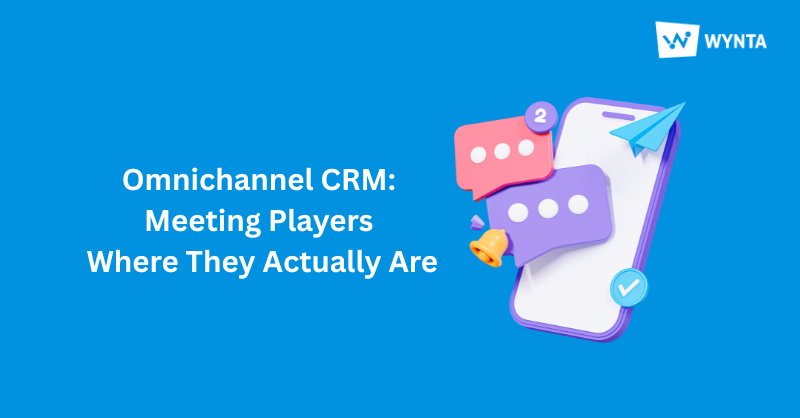
This is where Wynta’s CRM earns the “omnichannel” label rather than just claiming it. Every player gets their own agent, learning not just when to reach them and what to say but which channel that specific player actually responds to, and composing the next best offer accordingly across the entire base at once. A message that would have gone out as a generic in-app banner can go out as an SMS, a push notification or a WhatsApp message instead, whichever channel that player’s own behaviour says will actually get opened. And because Bonus Engine feeds Wynta’s CRM directly, whatever offer accompanies that message is issued and tracked in real time, regardless of which channel carried it.
As with every agent claim in Wynta’s CRM, the channel decision is not something an operator has to hand over blind. Run it autonomously across the base, keep a person reviewing which channel and message get paired before anything sends or manage channel strategy manually with no agent involvement at all. With you, or for you. What does not change is the standard the player is holding the operator to: reach me where I actually am, or do not expect me to notice you tried.
Operators still running CRM as if every player lives in the same app are working from an assumption 2026’s data no longer supports. If your player communication needs to meet people on the channel they actually use rather than the one that is easiest to send from, book a demo of Wynta’s CRM or talk to Wynta’s sales team at wynta.com.