White-label brands are leaving the market at a rate the industry has not seen before, and the obvious reading is that the model has run out of road. Oliver De Bono, Founder of Quantum Gaming, reads it differently. He sees a market that has finally started pricing itself honestly, which is roughly the moment his company has chosen to expand its partnership with Wynta across CRM, Gamification, Bonus Engine and Wynta AI.
Quantum Gaming runs a multi-tenant Player Account Management (PAM) platform, which lets it launch white-label and turnkey operators at a materially lower cost of hosting, integration and customisation than building each one from scratch. The same underlying transaction technology is built to scale, which gives Tier 1 and land-based operators a route off legacy systems that have become expensive to keep alive. The company works across technical discovery, migration, ongoing platform management and source-code solutions, which means De Bono spends a great deal of his time looking at the real economics of operators at both ends of the market.
Consolidation looks like collapse from the outside
His diagnosis is unsentimental.
“White label isn’t dying, it’s consolidating.”
The pressures behind that are cumulative rather than dramatic. Grey markets are shrinking. Regulation is increasing. Acquisition has never been more expensive, with SEO harder than it was, premium affiliate traffic priced accordingly, and the genuine cost of putting a player through the door still climbing.
Which has moved the entry price out of reach for a certain kind of operator. There was a period when €500,000 could realistically put a white-label casino live. In a Tier 1 regulated market today, De Bono says he would be extremely uncomfortable attempting it without several million behind the business, depending on the jurisdiction.
That sounds like a closing door, and for undercapitalised entrants it is. His more interesting point is what the same wall does for anyone already on the other side of it. A barrier high enough to stop most people is, by definition, a barrier your competitors also have to clear. Cost of entry and competitive protection turn out to be the same number viewed from opposite directions.
The affiliate invoice is not your acquisition cost
The costs operators underestimate are rarely the ones on the contract. De Bono’s argument is that the headline CPA, whether it arrives through paid media or an affiliate deal, is only a fraction of what acquisition actually costs.
The full figure has to carry the affiliate and marketing teams doing the work, the media spend behind them, the commissions paid out, and the operational overhead of running those channels at all. Then everything that surrounds the player once they arrive: bonuses, licensing and compliance, payments, CRM, affiliate software, infrastructure, and gaming staff experienced enough to be worth employing. Operators who benchmark themselves on the CPA line of an affiliate invoice are comparing themselves against a number that was never the cost.
Acquisition without retention is a subsidy
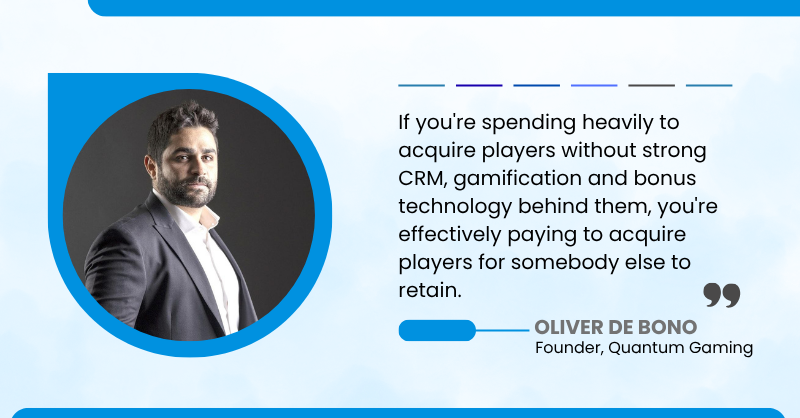
What happens after the deposit decides whether any of that spending was worth committing. Acquisition budget without serious CRM, gamification and bonus technology behind it produces players who arrive and then leave, and De Bono’s framing of that is blunt: you have paid to acquire players that somebody else will end up retaining. Sustainability, in his account, comes from understanding total acquisition cost against lifetime value, which is a harder calculation than the one most operators are running and a considerably more useful one.
Too little regulation and too much fail in the same direction
Asked whether tightening regulation has made the industry healthier or simply squeezed smaller operators, he declines to pick a side, because he thinks the question has a range rather than an answer.
“Regulation has a Goldilocks Zone. Too little creates abuse; too much creates a black market.“
Well-calibrated rules protect players and give serious casino and sportsbook operators something to point at. Push past that point and licensed businesses lose competitiveness against operators who never applied for a licence in the first place, and players drift towards them, arriving somewhere with markedly fewer protections than the market they left. De Bono’s test for any regulatory measure is therefore straightforward: it should keep players inside the regulated market rather than legislating them out of it.
Product stopped meaning the casino some time ago
There is a popular argument that product no longer differentiates anyone, and that operational efficiency and data have taken its place. De Bono thinks the argument is built on a definition that expired.
Product, as he defines it, is no longer the casino or the sportsbook. It is game availability, deposits, KYC, bonuses, gamification, withdrawals and every other step in the player journey. Data and operational efficiency did not replace product. They were absorbed into it, and the operators who talk about them as separate disciplines are describing an org chart rather than a player experience.
He is also unwilling to concede that innovation has stopped mattering, and points to a market that keeps demonstrating the opposite. Crash games disrupted the sector on their own terms. Prediction markets are now interrogating another set of assumptions. His warning is aimed at the alternative: an industry that rinses and repeats the same product is manufacturing saturation, not competition. If an operator genuinely believes in a different concept, his advice is to build it and hold the line on it.
Consolidating the stack, and the people behind it
The Wynta partnership sits directly on that logic. It gives Quantum Gaming a way to bring CRM, gamification, bonus technology and AI together around its PAM rather than assembling them from separate vendors with separate roadmaps, which matters more than usual given how much of De Bono’s definition of product now lives in exactly those systems.
What he emphasises, though, is the part that does not appear in an integration diagram. He has argued for some time that being able to speak to an actual person has quietly turned into a premium commodity in this industry. The value he places on the partnership is partly that Quantum can reach the Wynta team directly, explain what it needs and work a problem through with people who understand the product, instead of filing tickets into a queue or negotiating with a bot.
His position on AI follows from the same place, and it is a narrow one. He is convinced that AI should be making the product better. He is not convinced it should be standing in for the people behind it.
From grey markets to a harder, better opportunity
De Bono is candid that his own view has moved. He used to believe the significant opportunity sat in grey markets. He now thinks the larger prize is in regulated gaming, available to operators who understand acquisition, retention, technology and operational efficiency well enough to survive the entry cost.
That belief is what Quantum Gaming is built around. Multi-tenant technology keeps white-label and turnkey launches efficient enough to make sense at current economics, while the scalability of the underlying PAM and transaction layer offers Tier 1 and land-based operators a way off legacy systems they have outgrown. The company can pick that up at technical discovery, carry it through migration, and continue into ongoing management or hand over source-code ownership, depending on what the operator actually wants to own. The through-line is that a business finally being forced to mature needs infrastructure capable of maturing with it.
Multi-brand is not over, the clone is
None of which makes him a pessimist about brand proliferation. Players want different brands, different designs and different experiences, and they always have. One wants a sportsbook, another wants slots, another wants jackpots or live casino. Multi-brand strategy is not going anywhere.
What is ending is narrower and more specific: the traditional white-label arrangement, and the habit of launching an endless run of underfunded and virtually identical brands under someone else’s licence. That corner of the market is consolidating fastest, helped along by regulators asking licence holders to account properly for what sits beneath them.
“There will always be room for something new. There is increasingly less room for another copy of something old.“
Build on infrastructure that grows with you. Wynta brings CRM, Gamification, Bonus Engine and Wynta AI together in one platform, so operators can acquire, retain and monetise players without stitching four vendors into a roadmap. Book a demo or speak to our sales team at wynta.com.