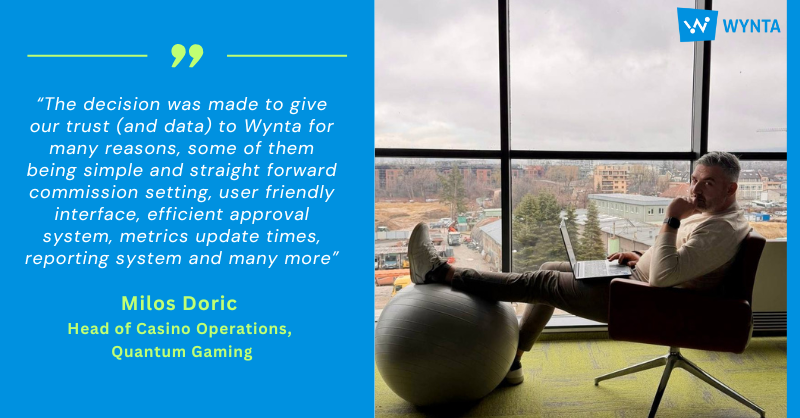
Milos Doric, Head of Casino Operations at Quantum Gaming, shares his perspective on regulatory shifts, technological agility and the future of player acquisition in an evolving iGaming landscape.
After 12 years in Malta, iGaming’s European heartland, Milos returned to Serbia, bringing with him a wealth of operational expertise and a clear-eyed view of where the industry is heading. Now leading casino operations at Quantum Gaming while balancing life as a father of two and advocate for genuine industry relationships, he offers insights that cut through the noise of regulatory anxiety to reveal opportunities for operators willing to adapt.
UK Regulation: A Cautionary Tale for Other Markets
While Quantum Gaming doesn’t currently operate in the UK market, Milos has been closely monitoring regulatory developments that could signal broader European trends. Two changes stand out: the increase in Remote Gaming Duty tax and the ban on mixed-product incentives, which prevents operators from tying bonuses or rewards to wagers across multiple product types.
These measures represent a significant shift in how operators can structure their acquisition strategies and monetization models. The mixed-product incentive ban, in particular, disrupts a long-standing cross-sell methodology that many operators have relied upon to maximize player lifetime value across their product suites.
Technology as the Great Equalizer
When asked about emerging trends, Milos’s response reveals a fundamental truth about modern iGaming success: regulatory and market shifts are only obstacles if your infrastructure can’t keep pace.
“There is no worry from our end in terms of the new and upcoming trends,” he explains. “When you sit on technology as powerful as ours (modular, flexible, easily adaptable to changes, AWS first etc.), pretty much the sky is the limit. There is no question if we can make something happen. The question becomes: how fast we can built it and what value will it generate.“
This isn’t just technological bravado, it reflects a strategic positioning that prioritizes adaptability over static optimization. Quantum Gaming’s architecture, built on Apache Ignite and AWS, supports both white-label and software-only models, enabling operators to respond to regulatory changes without complete platform overhauls.
The Stake Limit Paradox
Few topics in iGaming generate more heated debate than stake limits, particularly as jurisdictions like the UK continue tightening restrictions. Milos takes a balanced view that acknowledges short-term pain while recognizing long-term strategic value.
The downsides are clear: reduced short-term acquisition efficiency, lower early Average Revenue Per User (ARPU) and weakened bonus-driven funnels that have traditionally powered rapid player onboarding. These aren’t trivial concerns for operators competing in aggressive markets where customer acquisition costs continue climbing.
However, Milos identifies three critical advantages that often get overlooked in the immediate aftermath of stake limit implementation: improved player quality, stabilized lifetime value and reduced regulatory intervention costs. In essence, stake limits force a shift from volume-based to value-based player acquisition, a transition that aligns with broader industry maturation and sustainability trends.
Affiliate Strategy in Saturated Markets
When asked for advice to UK affiliates struggling with profitability in an increasingly crowded market, Milos’s first response “Try some other markets”. He draws a knowing laugh, but it contains genuine strategic wisdom. Geographic diversification remains one of the most underutilized tools in the affiliate playbook.
For those committed to the UK market, he recommends a specific tactical approach: “In a market as saturated as the UK is, one of the latest practices I suggest is targeting long tail keywords so you can keep up with the trends and stay relevant in the SEO game.“
This advice reflects the evolution of affiliate marketing from broad, high-volume keyword strategies to more nuanced, intent-driven approaches. Long-tail keywords typically face less competition, convert at higher rates and align better with specific player searches, particularly valuable as generic terms become prohibitively expensive and dominated by established players.
Partnership as Product Philosophy
After a year of working with Wynta, Milos’s experience highlights what operators actually value in affiliate tracking platforms. Following extensive research and testing of multiple solutions, Quantum Gaming selected Wynta based on practical operational needs: straightforward commission setting, user-friendly interfaces, efficient approval systems, real-time metrics updates and comprehensive reporting.
These may sound like table stakes, but the reality is that many affiliate platforms still struggle with these fundamentals. The choice reflects a broader philosophy at Quantum Gaming that partnerships should reduce operational friction, not create it.
Building for What Comes Next
Quantum Gaming’s positioning as a “next-generation iGaming platform” isn’t just marketing language, it’s an operational mandate. With global scalability, multi-brand management capabilities and a full suite of casino, sportsbook, payments and CRM modules, the platform is designed for operators who need to move quickly as markets and regulations evolve.
For Milos and his team, 2026 isn’t about weathering regulatory storms, it’s about building infrastructure that makes adaptation the default state rather than a crisis response. Whether that means adjusting to new UK tax structures, implementing stake limits or pivoting acquisition strategies toward emerging markets, the underlying philosophy remains consistent: flexibility is the only sustainable competitive advantage.
As iGaming continues its maturation from wild-west opportunism to regulated sustainability, operators who’ve invested in adaptable technology, quality player acquisition and genuine industry partnerships will find themselves better positioned for whatever regulatory shifts come next. For Milos and Quantum Gaming, that future looks less like a threat and more like an opportunity to prove what purpose-built infrastructure can accomplish.