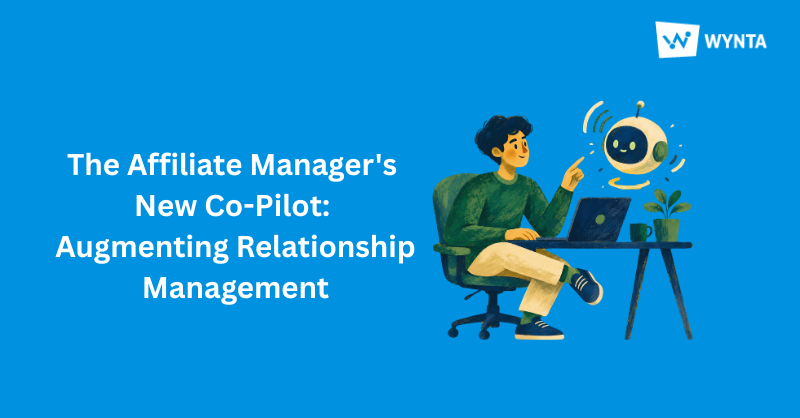
Ask any affiliate manager what actually fills their day and the answer is rarely the interesting part of the job. It is tracking link requests, reward plan updates, invoice chasing and logging into half a dozen brand dashboards to check the same numbers twice. Wynta‘s Affiliate Platform is built on the idea that a manager’s time is better spent on the relationship than on the admin around it, and in 2026 that idea has a name the industry has started using out loud: the AI co-pilot.
The case for it is not theoretical. The direction affiliate management automation has taken in 2026 is consistent across the sector: software that acts as a second set of hands for the people running affiliate programs, detecting traffic anomalies, suggesting offers and generating tracking links so the manager does not have to. The framing that has taken hold is deliberately modest, an AI-powered junior affiliate manager rather than a replacement for a senior one, built on a simple observation: removing friction from tracking link creation, reward plan updates and multi-brand account admin frees managers for the work that actually needs a human, building deals, optimising portfolios and assessing traffic quality.
That distinction matters more as affiliate portfolios get bigger rather than smaller. Consolidation has not slowed down. Genius Sports’ 1.2 billion dollar acquisition of affiliate network Legend is one recent example of scale continuing to concentrate in this space, and every operator managing a larger book of affiliates and sub-affiliates faces the same arithmetic: portfolios are growing faster than headcount, and the manual admin that used to be tolerable at a smaller scale starts to actively cost deals. A manager spending an afternoon reconciling reward plans across brands is an afternoon not spent on the relationship that would have grown the book. Industry-wide, the appetite for AI to close that gap is already there. A 2026 study from the University of Nevada, Las Vegas with KPMG found that more than 80% of gaming businesses have adopted generative AI for content and customer insight work, and affiliate operations are a natural next step for that same appetite.
Picture the difference in a fairly ordinary week. Without a co-pilot, a manager opens Monday by working through a backlog of tracking link requests from partners who emailed over the weekend, spends Tuesday reconciling last month’s reward plan changes across three brands because the numbers do not quite match between dashboards and only gets to an actual conversation with a top-performing affiliate on Thursday afternoon, rushed, because Wednesday went to invoice queries. With the busywork automated, the tracking links generate themselves, the reconciliation runs continuously rather than in a monthly scramble and Thursday’s conversation happens on Monday instead, with the manager arriving to it already knowing which partners are worth the call. Nothing about the relationship changed. Everything about how much of the week was left for it did.
This is exactly the layer Wynta AI is built to sit on top of. Wynta AI executes, analyses and optimises the campaigns and tasks running through Wynta’s Affiliate Platform. It helps affiliate managers strategise and automates the busywork underneath that strategy, leaving the manager to push only the final buttons rather than do the manual reconciliation themselves. Because Affiliate Platform already gives real-time tracking, granular commissions and sub-affiliate systems as the underlying data layer, Wynta AI has something worth acting on: it can flag a sub-affiliate sending unusual traffic patterns, surface which partners are outperforming their current commission tier or draft the numbers behind a reward plan change before a manager reviews and sends it. The judgment stays with the manager. The busywork does not have to.
None of this changes what Wynta’s Affiliate Platform actually does under the hood. It calculates commission owed, produces payout reporting and tracks payout status with the same precision it always has, across every affiliate and sub-affiliate in the program. What changes is how much of the manual work around that precision a human still has to do by hand, and who gets credit for the deal that grew because a manager had the afternoon free to work on it instead of a spreadsheet.
There is also a hiring question hiding inside this shift that operators are only starting to reckon with. The old assumption was that a growing affiliate book needed a proportionally growing team to service it, one manager per so many partners, more or less indefinitely. That arithmetic gets harder to justify once the majority of what filled a manager’s day was never the relationship work in the first place. It does not necessarily mean smaller affiliate teams. It more often means the same team covering a larger, more complex book without the admin scaling alongside it, and the managers already on staff spending a much higher proportion of their time on the work that actually grows the program rather than the work that just keeps it running.
It is also worth being precise about what a co-pilot is not. Nothing about this shift hands decision-making to software. A suggested offer is still a suggestion. A flagged anomaly still gets reviewed by a person who knows the partner and the context behind the numbers. The value of the automation is entirely in what it removes from a manager’s day, not in what it decides on their behalf. Operators evaluating these tools should stay just as skeptical of anything promising to run the affiliate program on their behalf as they are enthusiastic about the time savings, because the two are not the same pitch.
The affiliate managers who benefit most from this shift are not the ones looking to do less relationship management. They are the ones who have been doing too much admin to do enough of it. If your team is still reconciling reward plans by hand instead of building the next deal, book a demo of Wynta’s Affiliate Platform or talk to Wynta’s sales team at wynta.com.