There is a version of the white-label iGaming story that operators know all too well: a sleek platform demo, a signed contract and then the slow realisation that the technology is only half the battle. Running a competitive iGaming brand demands localised customer support, active CRM campaigns, affiliate relationships, VIP management and a marketing engine, none of which come pre-packaged with most platform deals. Nagesh Mekala, a senior figure at Czar Gaming, has built his career on closing exactly that gap.
Having personally closed over $15 million in white-label deals, Nagesh’s approach is not the typical vendor pitch. Where most providers hand over infrastructure and step back, Czar Gaming moves in the opposite direction, embedding itself in the day-to-day operations of the operators it works with.
The Managed Services Advantage in White-Label iGaming
The breakthrough insight behind Nagesh’s commercial success was identifying what iGaming operators consistently lacked once the platform was live. Most white-label providers deliver the connective tissue, i.e the tech layer that links payments, games, compliance tools and user interfaces, but leave operators to figure out the rest on their own. Customer support structures, sales and business development, CRM workflows, affiliate programs, agent management and cultural localisation are routinely underestimated, underfunded or simply absent.
Czar Gaming’s answer was to bundle all of it. By building centralised operational teams that any new brand can plug into: A standardised engine covering compliance, payments, hosting, CRM, marketing and VIP management. Nagesh’s team made launching and scaling a white-label brand dramatically simpler. The commercial logic follows naturally: when you are selling operators a running business rather than just software, multi-year deals with stronger SLAs and higher values become the norm rather than the exception.
Central to this approach was helping operators connect authentically with their target markets. “We worked closely with operators to build localised operational strategies that made their brands feel native and emotionally connected to their target markets,” Nagesh explains. That emotional connection, guiding clients on player engagement frameworks, retention campaigns and cultural positioning so that players perceived the brand as local and trustworthy, turned out to be a significant commercial differentiator.
Turning CRM and Support Into a Player Retention Engine
One of the more tangible outcomes of the managed services model is its measurable impact on churn. Nagesh points to a 20–40% churn reduction as a realistic target for operators who treat managed CRM and support not as supplementary headcount but as a data-driven engagement engine.
The mechanics are specific. On the CRM side, this means running behaviour-based personalised journeys, onboarding sequences, reactivation nudges, VIP care pathways and loss-limit interventions, so that at-risk players receive timely, relevant communication rather than generic promotional blasts. On the support side, it means centralising all channels, enforcing fast SLA tiers for high-value segments, and systematically addressing root-cause issues surfaced through tickets: payment friction, UX confusion, bonus misunderstandings.
“Operators can hit a 20–40% churn reduction range when they treat managed services not as ‘extra manpower’ but as a data-driven engagement engine tightly wired into CRM and support workflows,” Nagesh notes. The distinction matters because it reframes the investment. This is not a cost line, it is a retention infrastructure.
White-Label Platforms, Loyalty Tools and Affiliate Commission Opportunities
The white-label model’s value proposition extends to affiliate partners and Nagesh makes the case clearly. Platforms with native loyalty mechanics and gamification tools, tiered programmes, missions, tournaments, personalised rewards, directly increase the lifetime value (LTV) of every player an affiliate refers. Higher play frequency and repeat deposits translate into stronger RevShare and hybrid earnings and because these mechanics are integrated deeply with the platform via APIs, operators can set them up quickly and view performance at real-time on the affiliate program.
The downstream effect for affiliates is more predictable recurring revenue, better commission tiers and longer-term partnerships supported by healthier GGR and NGR figures. In short, better traffic quality from the same spend.
Key iGaming Managed Services Operators Need in 2026
Looking ahead, Nagesh sees a clear set of capabilities that operators need to add to their white-label arrangements to remain competitive. AI-powered personalisation sits at the top of the list: managed CRM journeys, smart bonusing and next-best-action recommendations that deliver the kind of individualised experience previously reserved for operators with large in-house data teams. Closely linked is an AI-augmented support and risk layer: 24/7 multilingual chat, automated KYC and AML workflows, and responsible gambling monitoring that keeps costs manageable while satisfying increasingly demanding regulators.
Growth operations, managed SEO, paid media, influencer campaigns and BI dashboards, round out the acquisition side, while RegTech capabilities covering regulatory reporting, licensing guidance and market entry playbooks are becoming essential for operators targeting LATAM, Brazil, the UK, Finland and other emerging markets.
How AI-Powered Affiliate Software Like Wynta Supports White-Label Growth
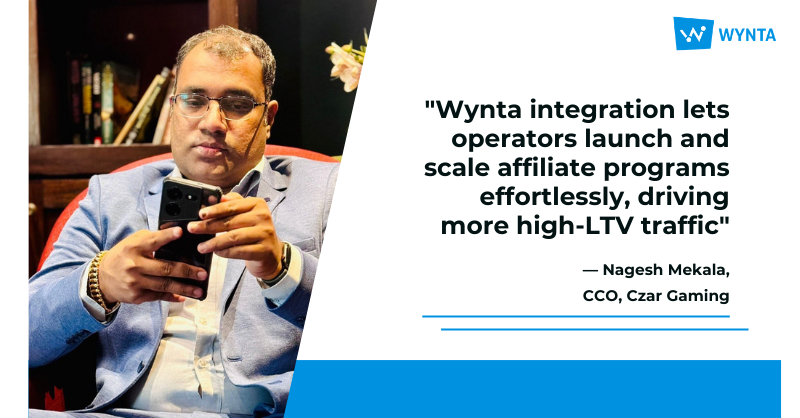
On the affiliate management side specifically, Nagesh sees Wynta‘s AI-powered affiliate management platform as a natural fit for the operator ecosystem Czar Gaming serves. “Wynta integration lets operators launch and scale affiliate programs effortlessly, driving more high-LTV traffic,” he says. The practical appeal is speed and intelligence: a full affiliate program can be live within minutes, with marketplace access to a large network of affiliates and real-time tracking from day one.
The AI layer on top adds the strategic dimension surfacing insights and recommendations that allow operators to scale smarter rather than simply bigger. For Czar Gaming’s clients, it adds enterprise-grade affiliate management as a managed service, reinforcing both acquisition performance and the overall attractiveness of white-label deals.
Czar Gaming’s iGaming Platform: Global Reach, Local Execution
Czar Gaming operates across LATAM, Southeast Asia, Europe, the Middle East and Africa, markets that share a common characteristic: they reward operators who invest in genuine localisation over those who apply a one-size-fits-all approach. The company’s differentiator is precisely that it does not hand over a platform and disappear. As Nagesh puts it, “We don’t just deliver the platform, but we sit in the shoes of the operator to understand the pain points and suggest the right solutions at the right time.“
That orientation, operator-first, operationally embedded, metrics-driven, is what has driven Czar Gaming’s commercial track record and continues to shape how Nagesh thinks about the future of white-label iGaming. In a market where technology is increasingly commoditised, the operators who win will be those with the best operational execution. Czar Gaming is betting that most of them will want a partner to help them get there.
Czar Gaming offers end-to-end white-label iGaming solutions with managed services spanning CRM, customer support, marketing, affiliates, VIP management and more. Learn more at czargaming.com.